ASK DR. JOHN
Patient Stories & Perspectives
Dr. John Jose E
Senior Interventional Cardiologist |
Structural Heart Specialist |
TAVI Specialist
 August 31, 2026
 10 minutes read
August 31, 2026
10 minutes read
What I Have Learned About Making the Right Decision at the Right Time
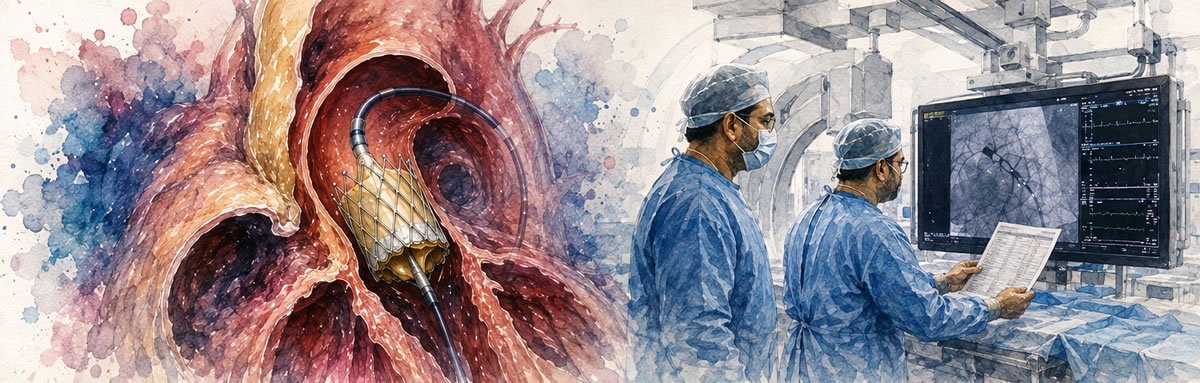
Over the years, I have sat across the table from many families who came to me with the same question:
“Doctor, is TAVI the right choice for my father or mother?”
Sometimes, my answer has been yes.
Sometimes, it has been no.
And sometimes, the most difficult part of my job has been explaining why.
I remember an elderly gentleman, about 70 years old, who came to see me with his family.
He had severe aortic stenosis, and on the face of it, the valve clearly needed treatment.
His children came with hope in their eyes. They had heard about TAVI and believed that if we could replace their father’s diseased valve, he would become better.
One of them looked at me and said,
“Doctor, we just want our father back. Forget about the expense. We will manage it somehow. He used to be so active. If you can fix his valve, will he become better?”
I wish every medical decision were that simple.
As I sat with them and went through his medical history, I realised that the valve was only one part of a much bigger problem.
He had significant health problems beyond his heart condition and had gradually lost much of his mobility. By the time he came to see me, he depended heavily on his family for many daily activities and had become largely chair or bed bound.
He had also become increasingly weak and had required several hospital admissions over the preceding months.
The valve was certainly a serious problem.
But it was not the only problem.
Looking at his children, I knew the conversation ahead would not be easy.
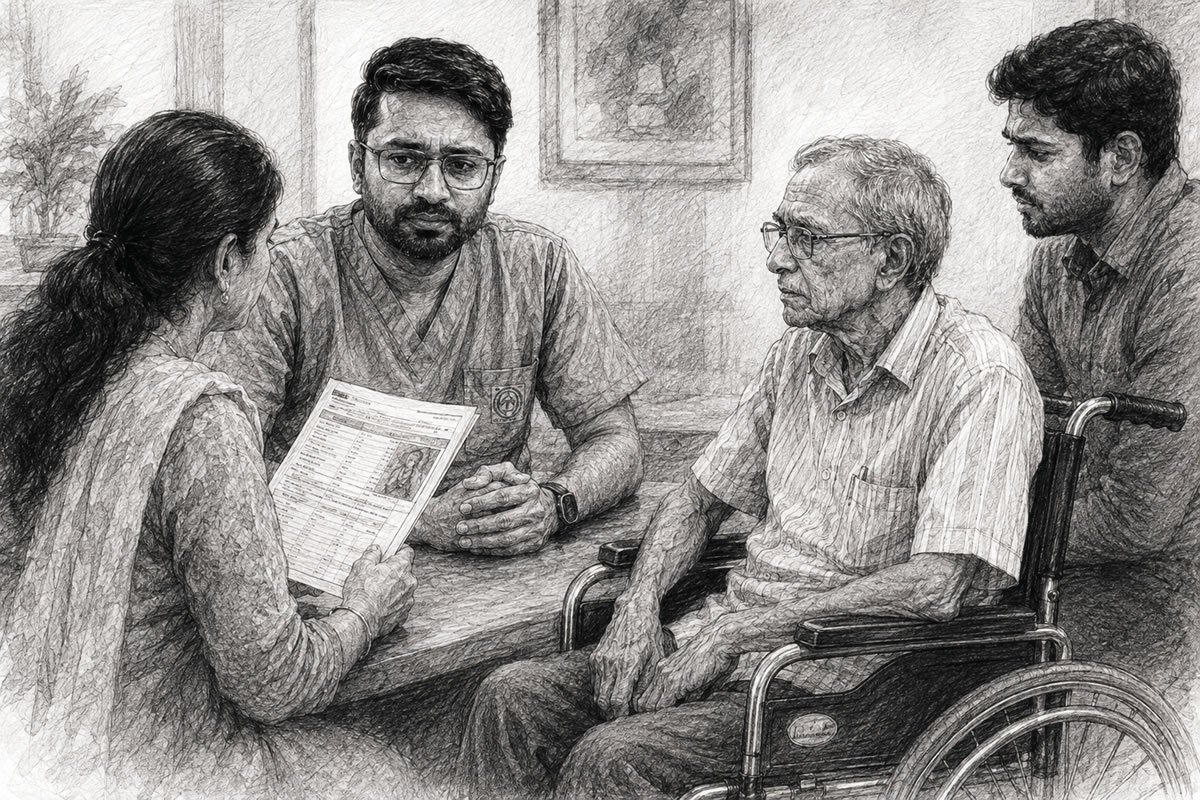
They had come all the way to see me, expecting a solution.
Instead, I had to tell them that, in their father’s particular situation, replacing the valve might not give him the improvement they were hoping for.
One of them asked,
“Doctor, but the valve is the major issue he is facing now, isn’t it? If you replace the valve, won’t everything else become better? Whatever other problems he has, we can manage those with the concerned specialists. Right now, we just want him to survive this immediate valve problem.”
I paused for a moment before answering.
“Your father’s valve is certainly a serious problem. But I have to look at your father as a whole. His heart is only one part of his health. Even if I successfully replace the valve, I am not sure his other health problems will allow him to recover in the way you are hoping.”
There was silence in the room.
I could see the disappointment on their faces.
They had probably spent days searching for information about TAVI and had come believing that this procedure would be the answer they had been searching for.
Then one of them asked quietly,
“Are you saying there is nothing more we can do for him?”
That is one of the hardest questions a family can ask a doctor.
I remember telling them,
“No. I am not saying that we are giving up on him. I am saying that we have to think about what will truly help him. Sometimes, doing a procedure because we can do it is not the same as doing what is best for the person.”
Another family member then asked,
“Doctor, if this was your father, what would you do?”
It was not an easy conversation.
As a doctor, I know how much families want me to say,
“Yes, we can fix this.”
But my responsibility is not simply to ask whether I can perform a procedure.
I have to ask whether I should.
I have to ask what the patient will truly gain from it.
I have to ask whether the treatment will give the patient a more meaningful life, or whether we are simply treating one part of a much larger illness.
In the end, I advised the family not to proceed with TAVI.
I still remember how downhearted they were as they walked out of my room and through the corridors of the hospital.
The patient, however, continued with appropriate medical management. As I later came to know, he lived for some time afterwards, surrounded by his family, in relative comfort before he passed away.
More time.
More conversations.
More family gatherings.
More ordinary moments that, to a family, are anything but ordinary.
Sometimes, I wonder what might have happened if we had been driven only by the desire to do something and had gone ahead with a procedure that I did not believe would truly benefit him.
Perhaps medicine is not always about doing more.
Sometimes, it is about knowing when enough is enough.
That experience stayed with me.
Sometimes, the right decision is to step back.
But over the years, I have also seen the opposite situation.
I remember another patient, about 78 years old, who came to me with severe aortic stenosis.
This time, after carefully assessing his overall health, his heart condition and the CT findings, I felt that TAVI could genuinely make a difference.
The valve needed treatment.
And, more importantly, I believed the patient had much to gain from it.
There was only one problem.
The moment I told him he needed a TAVI procedure, he was terrified.
To him, TAVI was no different from any other major surgery. He imagined an operation theatre, general anaesthesia and all the risks he associated with surgery.
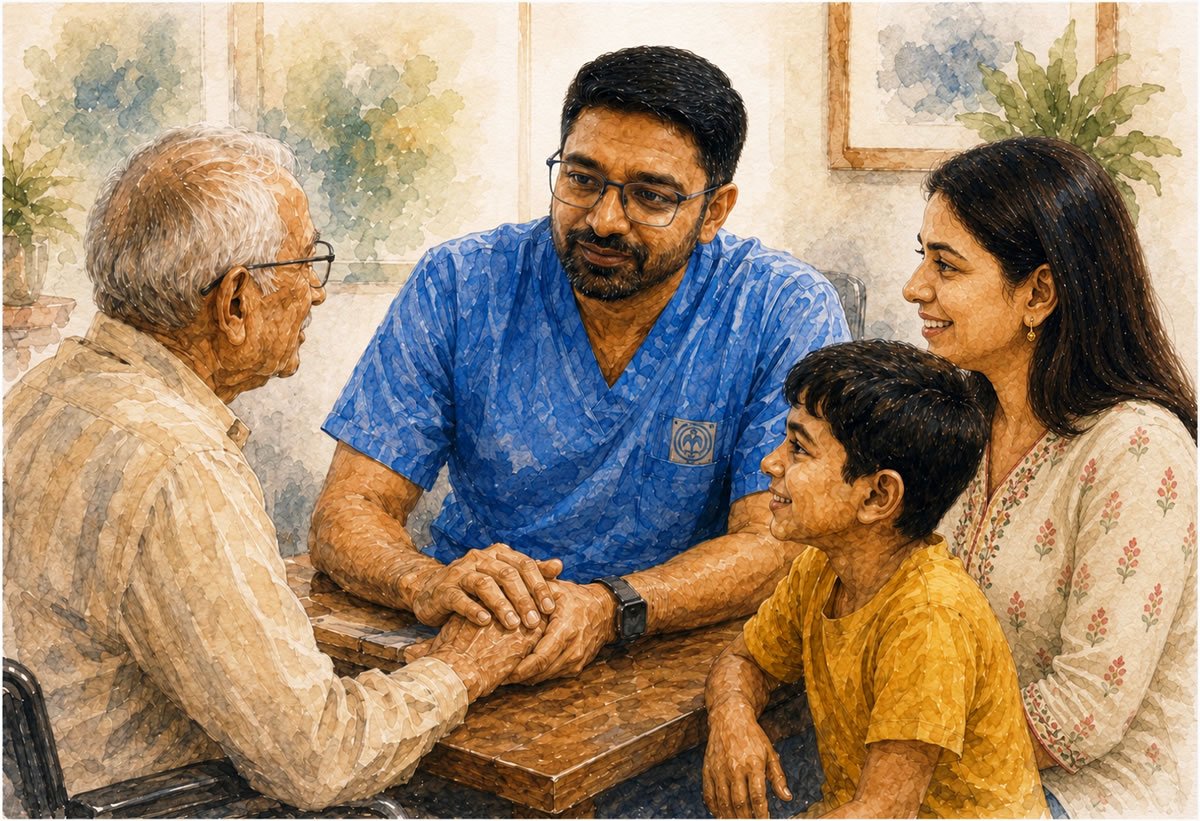
I remember him sitting in front of me and saying,
“Doctor, I am afraid. I don’t want to be taken to an operation theatre at this age. No way. I am scared. I don’t think I will survive. Please don’t put me through this.”
His children tried to reassure him.
But he was literally in tears with fear.
Nothing seemed to change his mind.
At one point, I turned to his children and said,
“I am not recommending TAVI simply because we can do it, or because you are insisting that I do it. I am recommending it because, after looking at your father as a whole person, I genuinely believe this could help him live better.”
Still, the patient was not convinced.
“Doctor, what if I don’t wake up?”
I told him,
“That is a fear many people have, and it is completely understandable. My job is not to tell you that there is no risk. My job is to understand your risk, explain it honestly, and help you make an informed decision.”
The family sat quietly.
I remember his daughter gently holding his hand.
Perhaps she, too, was afraid.
But they were trying to be strong for the person they loved.
We talked for a long time.
We went over his condition, the procedure, the CT findings, why we were recommending TAVI, the expected benefits, the possible risks, and what might happen if we did nothing.
Then I told him something I often tell families.
“You do not have to be brave because I am asking you to be brave. You only need to understand why we are recommending this and decide whether you are ready to take that step.”
There was a long pause.
Then he looked at his family and finally said something I remember to this day.
“Doctor, if you really believe this will help me, I will trust you. One day, all of us have to leave this world. I am putting myself in your hands and in God’s hands.”
For a moment, I was deeply moved by those words.
Together, the patient, his family and our team made the decision to move forward.
And so, we did.
The TAVI was performed.
And then something beautiful happened.
Life continued.
Not just for a few weeks.
Not just for a few months.
Years passed.
Today, that same patient is still living life.
More recently, I saw him again during one of his routine follow-up visits.
He smiled at me and said,
“Doctor, I was so frightened that day. Now I wonder why I was so afraid. If it were not for you, I might have left this world already.”
I knew what he meant.
He was not simply talking about the TAVI procedure itself.
He was remembering the time we had taken to help him overcome his fear and make the decision to accept the treatment he genuinely needed.
When I think about these two patients, I realise how different their journeys were.
In one, I had to advise against a procedure because I did not believe it would provide the benefit the family hoped for.
In the other, I had to help a frightened patient accept a treatment that I genuinely believed could give him more years of meaningful life.
Two different decisions.
But both required the same thing.
To look beyond the valve.
To look at the person.
A successful TAVI is not simply a technically successful procedure.
The valve may be implanted perfectly. The images may look excellent. The procedure may go exactly as planned.
But ultimately, we have to ask what that success means for the person.
Will they be able to walk again?
Will they be able to breathe more comfortably?
Will they be able to sit with their family, travel, attend a wedding, watch their grandchildren grow up or simply enjoy an ordinary morning without the limitations they had before?
Those are the outcomes that matter.
That is why the decision to proceed with TAVI cannot be based on the valve alone.
We have to understand the patient’s overall health, physical condition, frailty, expectations and fears.
We also have to understand what the patient wants from the years ahead.
And this is where the Heart Team becomes so important.
Different specialists bring different perspectives, but I believe there are two more important members of that team.
The patient.
And the family.
The patient is not simply someone to whom we offer a procedure.
The patient is part of the decision.
The family, too, has an important role.
They know the patient in ways that we may not.
They know how that person lived before illness took hold.
They know what brings them happiness.
They know what the patient values.
They know what a meaningful life means to that particular person.
So, when we sit down to decide whether TAVI is right, the conversation has to go beyond whether the procedure is technically possible.
What will this give this person?
Will it help them live better?
Will it help them return to the life they value?
And perhaps most importantly:
Will the benefit we hope to achieve be worth what the patient has to go through?
With experience, I have come to appreciate that the greatest achievement is not simply performing another successful TAVI.
It is knowing that we made the right decision for the right person at the right time.
I have always believed that God can perform miracles.
I believe that deeply.
But I also believe that, as doctors, we have a responsibility to do what is within our hands.
We have to make the right diagnosis.
We have to understand the person in front of us.
We have to know when to act.
And sometimes, we have to know when not to.
I do not believe that medicine, or any procedure, is about doing everything that is technically possible.
Sometimes, we can do more.
But that does not always mean that we should.
We have to act when action is needed.
We have to wait when waiting is wiser.
We have to step back when stepping back is the better choice.
And we have to step forward when the time is right.
Perhaps we cannot control the miracle.
But we can control the decisions that lead up to it.
For me, that is what individualised heart valve care is about.
It is not about doing the most.
It is about doing what is right.
At the right time.
For the right patient.
And then, having done what we can with all the knowledge, experience, empathy, compassion and personal care available to us, we leave the rest in God’s hands.
So, when someone you love is told that they may need TAVI, perhaps the first question should not simply be:
“Can TAVI be done?”
Perhaps the more important question is:
“Is TAVI right for this person?”
That is the question I believe we must always ask.
Because the person sitting in front of us is not simply a patient with a diseased valve.
He may be someone’s father.
She may be someone’s mother.
They may be a beloved grandparent.
They may be the person whose presence has shaped the lives of an entire family for decades.
They have dreams.
They have memories.
They have people who love them deeply.
Every heart carries a story.
And that story should matter when we make a medical decision.
Our responsibility is not simply to add another number to the procedures we have performed.
Our responsibility is to ask whether what we are offering will truly help the person in front of us.
Will it give them more meaningful time?
Will it help them return to the life they value?
Will it give their family more precious moments together?
If the answer is yes, we should have the courage to step forward.
If the answer is no, we should have the wisdom and compassion to step back.
Because every heart we treat belongs to someone.
And every someone is deeply loved by someone else.
So, perhaps the greatest measure of what we do is not how many valves we have replaced.
It is how many lives we have genuinely helped.
Let us not simply treat hearts.
Let us understand the stories each heart carries.
Let us care for each one as if it belongs to someone very important to us.
Because, in truth, it does.
Experience has certainly made me more confident.
But it has also reinforced the importance of humility, because every patient continues to teach us something new.
Every successful procedure reminds me that technology alone never guarantees success.
Preparation.
Judgement.
Teamwork.
Compassion.
Respect for every patient.
These values remain just as important today as they were when I first entered a Cath Lab in Germany.
Dr. John Jose E
Disclaimer:
The views expressed in my articles are my personal perspectives, shared for educational purposes and professional discussion. They are expressed in an individual capacity and do not necessarily represent the official views, policies, or positions of the organisations or institutions with which I am associated.
The information presented is intended for general awareness and education. It should not be considered a substitute for individual medical consultation, diagnosis or treatment. Medical decisions should be made in consultation with an appropriately qualified healthcare professional who can assess the patient’s individual circumstances. In a medical emergency, seek immediate medical assistance.