ASK Dr. JOHN
Self Diagnosis
Dr. John Jose E
Senior Interventional Cardiologist |
Structural Heart Specialist |
TAVI Specialist
 October 16, 2026
 10 minutes read
October 16, 2026
10 minutes read
What happens when a symptom becomes a Google search, a search becomes a diagnosis, and a diagnosis becomes a self-treatment plan? In an age of Google, AI and instant medical information, where should informed patients draw the line?
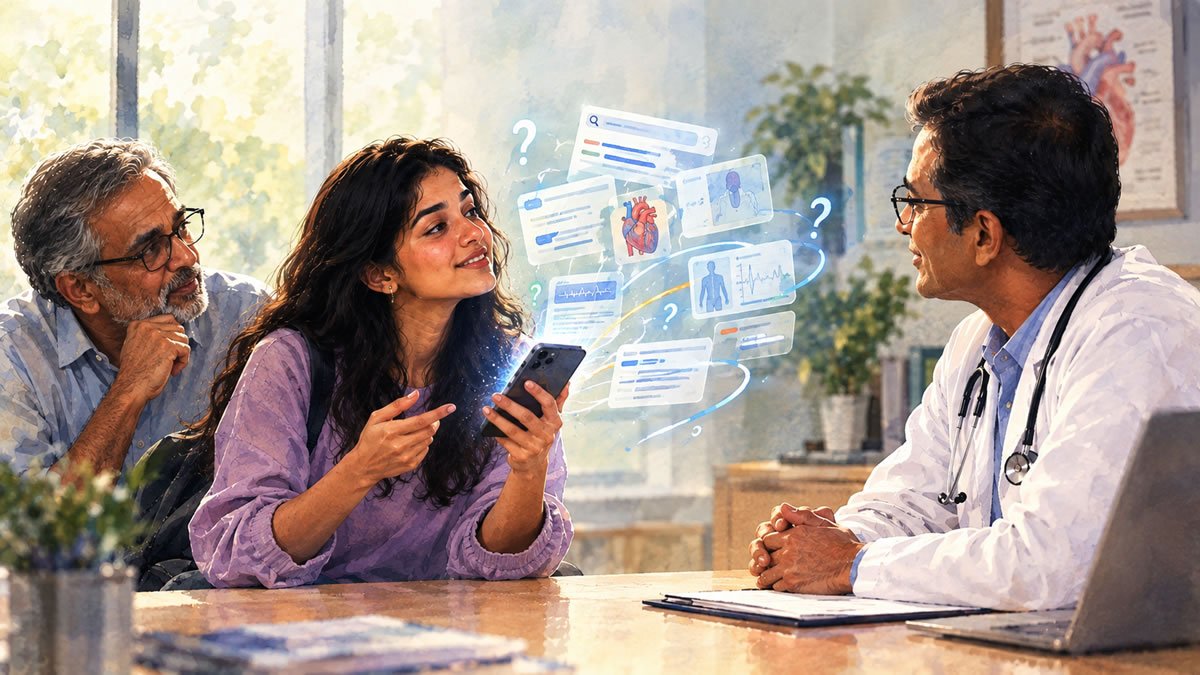
There is something I have noticed over the years.
More and more, when a patient comes to see a doctor, they do not come alone.
Sometimes, Google comes with them.
Sometimes, an AI tool comes with them.
And sometimes, a friend, a relative or a neighbour comes along too, through the stories they have already shared.
In fact, these days, a patient may arrive with a surprisingly large medical team.
Google. AI. A WhatsApp group. A neighbour who “knows someone who had exactly the same thing.”
I say this with a smile because, if I am honest, many of us do the same thing.
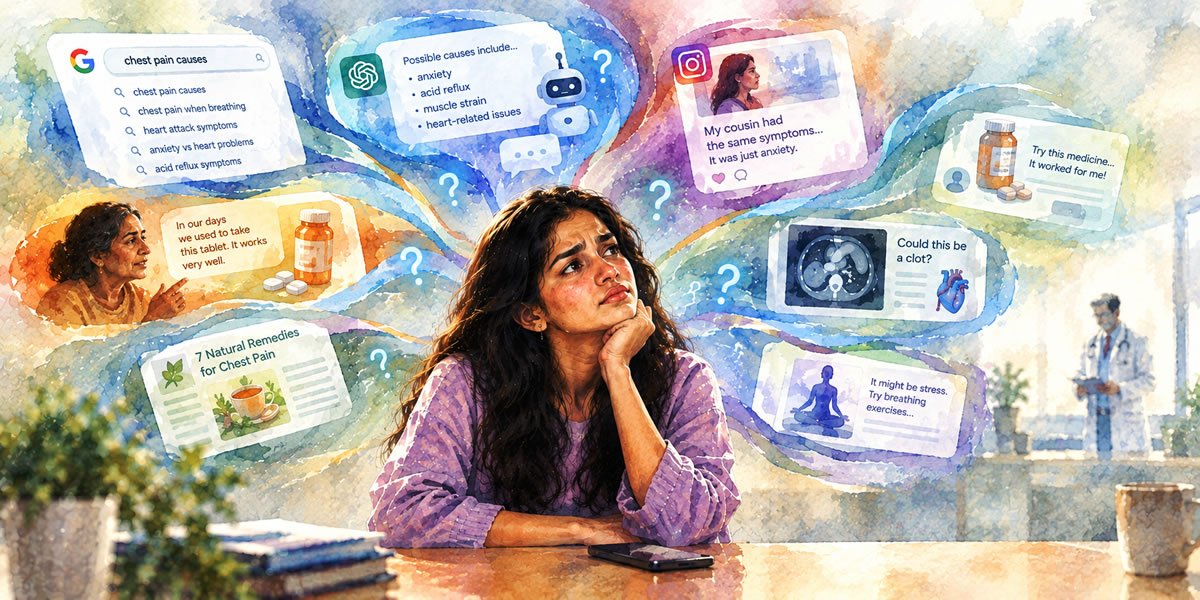
You have a headache. You search it.
You feel some discomfort in your chest. You search it.
You notice that you have been unusually tired for a few days. You search it.
I have friends who search every symptom before calling a doctor. I know family members who read every possible side effect of a medicine before taking the first tablet.
Sometimes it is a late night search when everyone else at home is asleep.
You start with “Why am I feeling tired?” and twenty minutes later, the internet has introduced you to seventeen diseases you did not know existed.
Sometimes it is looking at a scan report and searching every unfamiliar word before speaking to the doctor.
Sometimes it is reading about a medicine and suddenly wondering whether every small change in the body could be a side effect.
And sometimes, after all that searching, we arrive at the consultation with an answer already forming in our minds.
I understand why we do it.
When someone we love is unwell, uncertainty can be frightening.
We want answers.
We want reassurance.
And today, answers seem to be only a few seconds away.
But there is something I would like every patient and every family to remember.
Information can help us ask better questions. But information alone cannot replace medical judgement.
The interesting part is what happens next.
What happens when a search becomes a possibility, a possibility becomes a diagnosis, and that diagnosis begins to influence what we do?
That is where being informed can quietly turn into believing we already know.
A patient feels chest discomfort.
They search for it.
Within seconds, they may find dozens of possible explanations. Some are harmless. Some are serious. Some are rare. Many sound remarkably similar.
The same happens with breathlessness, dizziness, palpitations, fatigue, swelling, abdominal discomfort, headaches and countless other symptoms.
The internet is very good at giving us possibilities.
Medicine has to answer a different question:
Which possibility actually fits this person?
That requires a story.
When did the symptom begin? What brings it on? What makes it better? What other symptoms are present? What illnesses does the person already have? What medicines are they taking? What does the examination show? What do the investigations reveal?
Two people can describe the same symptom and have completely different illnesses.
And somehow, the rarest possibility often feels like the most interesting one.
The more possibilities we see, the easier it can become to recognise ourselves in several of them.
But medicine is not simply about finding a disease that sounds familiar.
It is about understanding which possibility actually fits the person sitting in front of us.
That is why information is not diagnosis.
A search engine does not examine you.
It does not listen to your heart.
It does not feel your pulse.
It does not know what your previous reports looked like.
And it does not sit with you long enough to understand the story behind the symptom.
Medicine is not simply about matching a symptom to a disease.
It is about understanding the person who has the symptom.
Today, Google is no longer the only source of instant medical information.
AI has entered the conversation too.
A patient may ask an AI tool to explain a scan report, interpret a symptom, compare medicines, suggest possible diagnoses or even recommend what to do next.
Used carefully, these tools can be useful.
They can translate medical language into simpler language. They can help a patient prepare questions. They can help someone understand a condition after a doctor has explained it.
But there is an important difference between understanding information and making a medical decision.
An AI tool can produce an answer that sounds confident, organised and convincing. That does not necessarily make the answer correct.
After all, sounding confident has never been the same thing as being right.
So if a patient comes to me and says,
“Doctor, I read this. Could this be relevant to me?”
that can be a very useful beginning to a consultation.
But if the conclusion has already become,
“Doctor, I know what I have. This is what I need,”
the conversation has become more difficult.
A good question can strengthen a consultation. A premature conclusion can weaken it.
The purpose of information should be to open the conversation, not close it.
This becomes particularly important with medicines.
A patient reads about the possible side effects of a medicine.
Perhaps the medicine is causing one of those effects.
Or perhaps the symptom has nothing to do with the medicine.
But once we read that a medicine can cause something, it is surprisingly easy to start seeing every new symptom through that explanation.
There is another curious thing that can happen when we spend a little too much time searching.
We may begin with a symptom.
Then we search the symptom.
Then we search the diagnosis.
Then we start reading about the medicines used to treat it.
And somewhere along the way, something changes.
Give us a symptom, a prescription and twenty minutes with Google, and some of us are almost ready to take over the consultation.
I say that with a smile because the intention is usually not careless.
It often comes from wanting to be safe.
But sometimes, a medicine prescribed by a doctor may suddenly look unnecessary because we have read about its side effects.
Another medicine may appear more suitable because someone online had a good experience with it.
And sometimes, after reading enough, we may even decide that the tablets prescribed after a consultation belong in the garbage bin.
That is where caution is needed.
We may know the name of the medicine. We may know what it is used for. We may even know its common side effects.
What we may not know is why that particular medicine was prescribed for that particular person, at that particular dose, at that particular time.
A medicine may have been prescribed because of a particular risk, a previous event, a test result, or a combination of several conditions.
The decision may also have taken into account the patient’s age, medical history, examination findings, other medicines and the risks of leaving the underlying condition untreated.
Stopping it may remove its intended benefit.
At the same time, a genuine side effect should never be ignored.
That is precisely why the conversation with the treating doctor matters.
A medicine can have a side effect. But an untreated disease can have consequences too.
The right question is therefore not simply:
“Is this medicine causing my symptom?”
It is:
“What is happening to me, what could be causing it, and what should we do next?”
That difference may appear small.
Clinically, it can be enormous.
So by all means, ask.
Read the prescription.
Look up the medicines.
Understand what you are taking.
But before throwing a prescribed medicine into the bin, perhaps there is one more step worth taking:
Ask the doctor who prescribed it why it is there.
That conversation may be far more useful than the search that made us question it in the first place.
Doctors are not the only people patients turn to for health information.
A friend may say, “I had exactly the same thing.”
A relative may say, “My husband had this and the doctor gave him this medicine.”
A pharmacist may offer advice based on experience and familiarity with medicines.
And somewhere, there may already be a WhatsApp message waiting:
“Try this medicine. It worked for my uncle.”
All of these voices can have value.
Pharmacists, nurses and other healthcare professionals play important roles in patient care. Their knowledge and experience can be extremely helpful.
But healthcare is a team effort for a reason.
Symptoms can be shared. Diagnoses cannot be assumed.
Your friend may have had the same symptom but a completely different condition.
Your relative may have been prescribed a particular medicine for reasons that do not apply to you.
A pharmacist may identify an important medication issue, while the complete clinical picture may still require assessment by the appropriate members of the healthcare team.
No single member of the healthcare team can replace the entire team.
A test report is important.
A scan is important.
A blood result is important.
A medical history is important.
But none of these, viewed in isolation, necessarily tells the whole story.
Medicine is often the process of bringing those pieces together.
I think medicine has changed enormously during my lifetime.
We have more information than any previous generation.
We can access medical knowledge from almost anywhere.
Artificial intelligence is opening new possibilities.
Technology is making healthcare more connected.
These are wonderful developments.
But sometimes, with all this information around us, we may forget something very simple.
A patient is not a search result.

A patient is not an AI generated possibility.
A patient is a human being.
With a history.
With fears.
With a family.
With hopes.
And with a life that cannot be understood by a search box alone.
There is one question I would ask before allowing something we have read to influence a decision about our health, or the health of someone we love:
If this were not just about information, but about a life, would we trust the search result to make the decision for us?
Perhaps that is the distinction we need to remember.
Google can tell us what a symptom might mean.
It can tell us what a medicine can cause.
It can give us possibilities, explanations and thousands of pages of information.
But it does not know which of those possibilities belongs to you.
It does not carry the responsibility for the decision.
And it cannot replace the person who examines you, understands your history, interprets your reports and considers the whole picture before recommending what should happen next.
That is why information should make us more curious, not more certain.
Before we decide that we know what is wrong, perhaps we should pause and ask:
“Do I know enough to make this decision, or do I simply know enough to ask a better question?”
That small pause can make a very big difference.
So, if you ever find yourself searching your symptoms late at night, I will not tell you to put the phone away.
Search.
Read.
Learn.
But when you finish, remember one thing:
You have gathered information. You have not yet gathered the whole story.
Bring what you found to your doctor.
Tell them what you read.
Ask your questions.
Listen to their explanation.
And then make your decision with the full picture in front of you.
Because the goal of being an informed patient is not to become your own doctor.
It is to become a better partner in your own care.
I believe that is where the balance lies.
We should welcome information.
We should embrace technology.
We should use AI responsibly.
We should encourage patients to ask questions.
But we should never lose the value of human judgement, clinical experience and the relationship between a doctor and a patient.
Because medicine, at its heart, is still about one human being caring for another.
Google can inform us.
AI can help us understand.
But healing still begins when knowledge meets judgement, and information meets humanity.
That, to me, is the balance we must never lose.
A search engine does not examine you.
It does not listen to your heart.
It does not feel your pulse.
It does not know what your previous reports looked like.
And it does not sit with you long enough to understand the story behind the symptom.
Medicine is not simply about matching a symptom to a disease.
It is about understanding the person who has the symptom.
Today, Google is no longer the only source of instant medical information.
AI has entered the conversation too.
A patient may ask an AI tool to explain a scan report, interpret a symptom, compare medicines, suggest possible diagnoses or even recommend what to do next.
Used carefully, these tools can be useful.
They can translate medical language into simpler language. They can help a patient prepare questions. They can help someone understand a condition after a doctor has explained it.
But there is an important difference between understanding information and making a medical decision.
An AI tool can produce an answer that sounds confident, organised and convincing. That does not necessarily make the answer correct.
After all, sounding confident has never been the same thing as being right.
So if a patient comes to me and says,
“Doctor, I read this. Could this be relevant to me?”
that can be a very useful beginning to a consultation.
But if the conclusion has already become,
“Doctor, I know what I have. This is what I need,”
the conversation has become more difficult.
A good question can strengthen a consultation. A premature conclusion can weaken it.
The purpose of information should be to open the conversation, not close it.
This becomes particularly important with medicines.
A patient reads about the possible side effects of a medicine.
Perhaps the medicine is causing one of those effects.
Or perhaps the symptom has nothing to do with the medicine.
But once we read that a medicine can cause something, it is surprisingly easy to start seeing every new symptom through that explanation.
There is another curious thing that can happen when we spend a little too much time searching.
We may begin with a symptom.
Then we search the symptom.
Then we search the diagnosis.
Then we start reading about the medicines used to treat it.
And somewhere along the way, something changes.
Give us a symptom, a prescription and twenty minutes with Google, and some of us are almost ready to take over the consultation.
I say that with a smile because the intention is usually not careless.
It often comes from wanting to be safe.
But sometimes, a medicine prescribed by a doctor may suddenly look unnecessary because we have read about its side effects.
Another medicine may appear more suitable because someone online had a good experience with it.
And sometimes, after reading enough, we may even decide that the tablets prescribed after a consultation belong in the garbage bin.
That is where caution is needed.
We may know the name of the medicine. We may know what it is used for. We may even know its common side effects.
What we may not know is why that particular medicine was prescribed for that particular person, at that particular dose, at that particular time.
A medicine may have been prescribed because of a particular risk, a previous event, a test result, or a combination of several conditions.
The decision may also have taken into account the patient’s age, medical history, examination findings, other medicines and the risks of leaving the underlying condition untreated.
Stopping it may remove its intended benefit.
At the same time, a genuine side effect should never be ignored.
That is precisely why the conversation with the treating doctor matters.
A medicine can have a side effect. But an untreated disease can have consequences too.
The right question is therefore not simply:
“Is this medicine causing my symptom?”
It is:
“What is happening to me, what could be causing it, and what should we do next?”
That difference may appear small.
Clinically, it can be enormous.
So by all means, ask.
Read the prescription.
Look up the medicines.
Understand what you are taking.
But before throwing a prescribed medicine into the bin, perhaps there is one more step worth taking:
Ask the doctor who prescribed it why it is there.
That conversation may be far more useful than the search that made us question it in the first place.
Doctors are not the only people patients turn to for health information.
A friend may say, “I had exactly the same thing.”
A relative may say, “My husband had this and the doctor gave him this medicine.”
A pharmacist may offer advice based on experience and familiarity with medicines.
And somewhere, there may already be a WhatsApp message waiting:
“Try this medicine. It worked for my uncle.”
All of these voices can have value.
Pharmacists, nurses and other healthcare professionals play important roles in patient care. Their knowledge and experience can be extremely helpful.
But healthcare is a team effort for a reason.
Symptoms can be shared. Diagnoses cannot be assumed.
Your friend may have had the same symptom but a completely different condition.
Your relative may have been prescribed a particular medicine for reasons that do not apply to you.
A pharmacist may identify an important medication issue, while the complete clinical picture may still require assessment by the appropriate members of the healthcare team.
No single member of the healthcare team can replace the entire team.
A test report is important.
A scan is important.
A blood result is important.
A medical history is important.
But none of these, viewed in isolation, necessarily tells the whole story.
Medicine is often the process of bringing those pieces together.
I think medicine has changed enormously during my lifetime.
We have more information than any previous generation.
We can access medical knowledge from almost anywhere.
Artificial intelligence is opening new possibilities.
Technology is making healthcare more connected.
These are wonderful developments.
But sometimes, with all this information around us, we may forget something very simple.
A patient is not a search result.

A patient is not an AI generated possibility.
A patient is a human being.
With a history.
With fears.
With a family.
With hopes.
And with a life that cannot be understood by a search box alone.
There is one question I would ask before allowing something we have read to influence a decision about our health, or the health of someone we love:
If this were not just about information, but about a life, would we trust the search result to make the decision for us?
Perhaps that is the distinction we need to remember.
Google can tell us what a symptom might mean.
It can tell us what a medicine can cause.
It can give us possibilities, explanations and thousands of pages of information.
But it does not know which of those possibilities belongs to you.
It does not carry the responsibility for the decision.
And it cannot replace the person who examines you, understands your history, interprets your reports and considers the whole picture before recommending what should happen next.
That is why information should make us more curious, not more certain.
Before we decide that we know what is wrong, perhaps we should pause and ask:
“Do I know enough to make this decision, or do I simply know enough to ask a better question?”
That small pause can make a very big difference.
So, if you ever find yourself searching your symptoms late at night, I will not tell you to put the phone away.
Search.
Read.
Learn.
But when you finish, remember one thing:
You have gathered information. You have not yet gathered the whole story.
Bring what you found to your doctor.
Tell them what you read.
Ask your questions.
Listen to their explanation.
And then make your decision with the full picture in front of you.
Because the goal of being an informed patient is not to become your own doctor.
It is to become a better partner in your own care.
I believe that is where the balance lies.
We should welcome information.
We should embrace technology.
We should use AI responsibly.
We should encourage patients to ask questions.
But we should never lose the value of human judgement, clinical experience and the relationship between a doctor and a patient.
Because medicine, at its heart, is still about one human being caring for another.
Google can inform us.
AI can help us understand.
But healing still begins when knowledge meets judgement, and information meets humanity.
That, to me, is the balance we must never lose.
Dr. John Jose E
Disclaimer:
The views expressed in my articles are my personal perspectives, shared for educational purposes and professional discussion. They are expressed in an individual capacity and do not necessarily represent the official views, policies, or positions of the organisations or institutions with which I am associated.
The information presented is intended for general awareness and education. It should not be considered a substitute for individual medical consultation, diagnosis or treatment. Medical decisions should be made in consultation with an appropriately qualified healthcare professional who can assess the patient’s individual circumstances. In a medical emergency, seek immediate medical assistance.